How Infographics and Layouts Can Save Your College Essays
The traditional college essay is undergoing a massive transformation. For decades, the “gold standard” of academic success was a dense, black-and-white wall of text. But as we move further into a visually-driven digital age, professors and admissions officers are shifting their expectations. They aren’t just looking for what you say; they are looking at how clearly you communicate complex ideas. Integrating infographics and thoughtful layouts into your assignments is no longer just a “bonus”—it is a survival skill for the modern student.
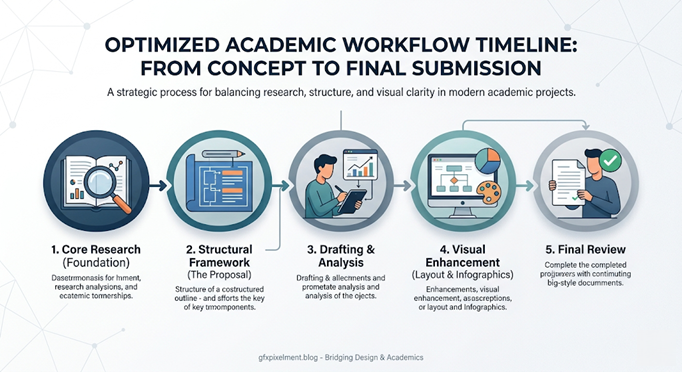
When you sit down to draft a major project, the structural requirements can feel overwhelming. Many students realize that a strong visual presentation cannot hide a weak academic foundation. This is why many top-tier students choose to buy research proposal online to establish a professional framework before they begin the creative design process. By starting with a high-quality, expertly structured proposal, you ensure that your core arguments are academically sound, giving you the freedom to focus on how to visually represent that data to make an impact.
Why the “Wall of Text” is Failing Modern Students
The human brain processes images 60,000 times faster than text. In a pile of a hundred essays, the one that utilizes a clean layout, consistent typography, and helpful diagrams is the one that stays in the reader’s memory. When an undergraduate student submits a 2,000-word paper without a single sub-heading or visual break, they are essentially asking the professor to do the heavy lifting of organization.
Good layout design acts as a roadmap. It tells the reader which points are primary and which are supporting details. By using white space effectively, you reduce “cognitive load,” which is the amount of mental effort required to process information. If your essay is easy to navigate, your arguments feel more persuasive.
The Anatomy of a High-Impact Academic Infographic
You don’t need to be a professional graphic designer to include visuals in your work. In fact, over-designed graphics can sometimes distract from the academic tone. The goal is clarity. Consider these three types of visuals that work best in a college setting:
- Process Flowcharts: Perfect for explaining a methodology or a sequence of historical events.
- Comparison Tables: Ideal for showing the differences between two theories or scientific outcomes.
- Data Summaries: A simple bar chart or pie graph can replace three paragraphs of tedious number-crunching.
Comparison: Traditional vs. Visual-Integrated Essays
| Feature | Traditional Essay Style | Visual-Integrated Style |
| Readability | High effort; prone to reader fatigue. | High scannability; keeps the reader engaged. |
| Data Retention | Hard to remember specific statistics. | Key data points stand out in charts. |
| Structure | Dependent entirely on transition words. | Enhanced by headings and logical breaks. |
| Professionalism | Standard and expected. | Modern, forward-thinking, and impressive. |
Merging Creativity with Academic Rigor
The biggest mistake a student can make is choosing style over substance. An infographic is only as good as the data behind it. If your essay looks beautiful but lacks critical analysis, it will not pass. This is especially true in humanities and social sciences, where the nuance of your argument is everything.
Managing this balance is difficult, especially during finals week when multiple deadlines collide. If you find yourself struggling to maintain the quality of your writing while focusing on these new visual standards, you can buy college essays online from MyAssignmentHelp to see how professionals balance complex narratives with clear, readable structures. Using these resources as a reference helps you understand the level of detail required to earn top marks, allowing you to then apply your own visual “flair” to a solid academic base.
Strategic Layout Tips for Undergraduates
- Use Hierarchy: Your H1 (Main Title) and H2 (Sub-headings) should follow a consistent font and size. This helps the reader understand the “levels” of your argument.
- The Rule of Proximity: Keep your charts and images close to the text that explains them. Never make a professor scroll three pages to find the diagram you just referenced.
- Consistency in Color: If you use a specific color for your primary data points in one chart, use that same color throughout the paper. This creates a “visual language” for your essay.
- Captions are Mandatory: Every visual must have a caption. A caption should not just say what the image is, but why it matters to your argument.
The Role of E-E-A-T in Modern Grading
In 2026, the concept of E-E-A-T (Experience, Expertise, Authoritativeness, and Trustworthiness) isn’t just for Google search results; it’s a mindset for academic writing. When you include a well-cited infographic, you are demonstrating Expertise. When you organize your paper with a professional layout, you are building Trustworthiness with your instructor. You are showing that you care about the delivery of your knowledge as much as the knowledge itself.
Overcoming the “Spammy” Look
A common fear among students is that adding images will make their paper look like a blog post or a sales brochure. To avoid this, keep your visuals “academic.” Avoid bright, neon colors or “clipart” style icons. Stick to muted professional tones (blues, grays, and deep greens) and high-resolution images. Every visual element should serve a purpose. If an image doesn’t explain a concept better than words can, leave it out.
Conclusion: The Future is Multi-Modal
Writing is no longer just about the alphabet. It is about communication in all its forms. By learning how to integrate infographics and logical layouts into your college essays, you are preparing yourself for a professional world that values “at-a-glance” information. Whether you are drafting a research proposal or a final year thesis, remember that clarity is your greatest ally. Start with a strong, professionally guided foundation, and use the tools of design to make your voice heard in a crowded academic landscape.
Frequently Asked Questions (FAQ)
Q.1. Do professors actually allow images in essays?
Ans: Most modern rubrics encourage “multi-modal” communication. However, always check your specific department’s style guide (APA, MLA, or Chicago) for rules on how to label and cite figures and tables.
Q.2. Can I use AI to generate my infographics?
Ans: While AI can help with layout ideas, you should manually input your data to ensure accuracy. Professors look for “Information Gain”—original insights that only you, the student, can provide.
Q.3. What are the best free tools for creating essay visuals?
Ans: Tools like Canva, Adobe Express, and even Google Sheets are excellent for creating clean, professional-looking charts and diagrams without needing a background in graphic design.
Q.4. How many images are too many?
Ans: A good rule of thumb is one visual for every 750–1000 words, unless the assignment is specifically a visual report. Quality always beats quantity.
Q.5. How do I cite an infographic I made myself?
Ans: Usually, you label it as “Figure 1: Title of Image,” and in your text, you refer to it (e.g., “As shown in Figure 1…”). Since you created it based on your own research, you don’t need an external citation, but you must cite the data sources used to build it.
About The Author
Hello! I am Zara Williams, a senior academic strategist at MyAssignmentHelp with over a decade of experience in digital content curation. My work focuses on bridging the gap between traditional research methodologies and modern digital presentation to help students achieve E-E-A-T standards in their submissions.